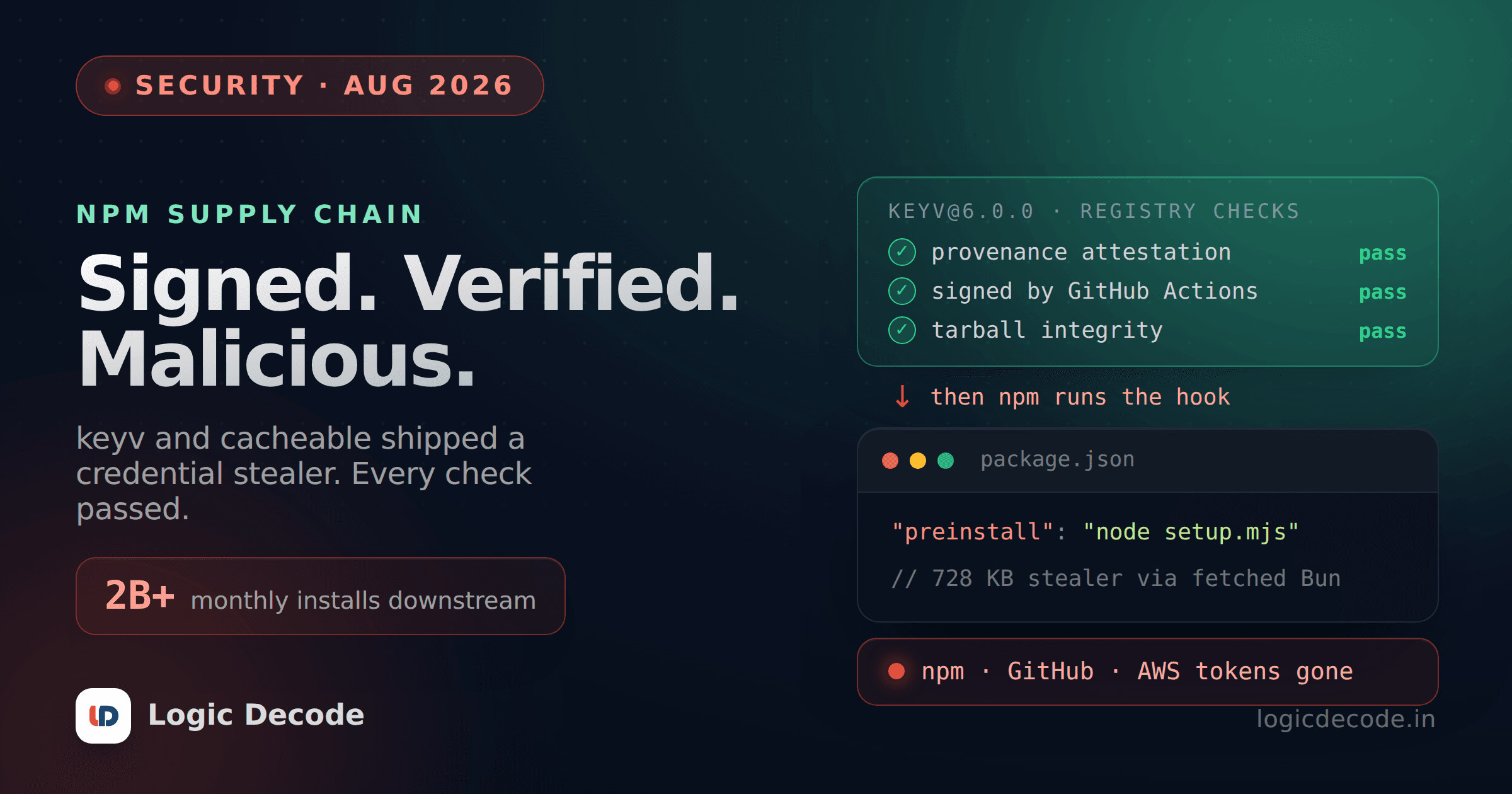
TypeScript Overtakes Python as GitHub's #1 Language
TypeScript just passed Python to become GitHub's most-used language. The real story isn't hype. It's why type safety quietly won in the AI era.

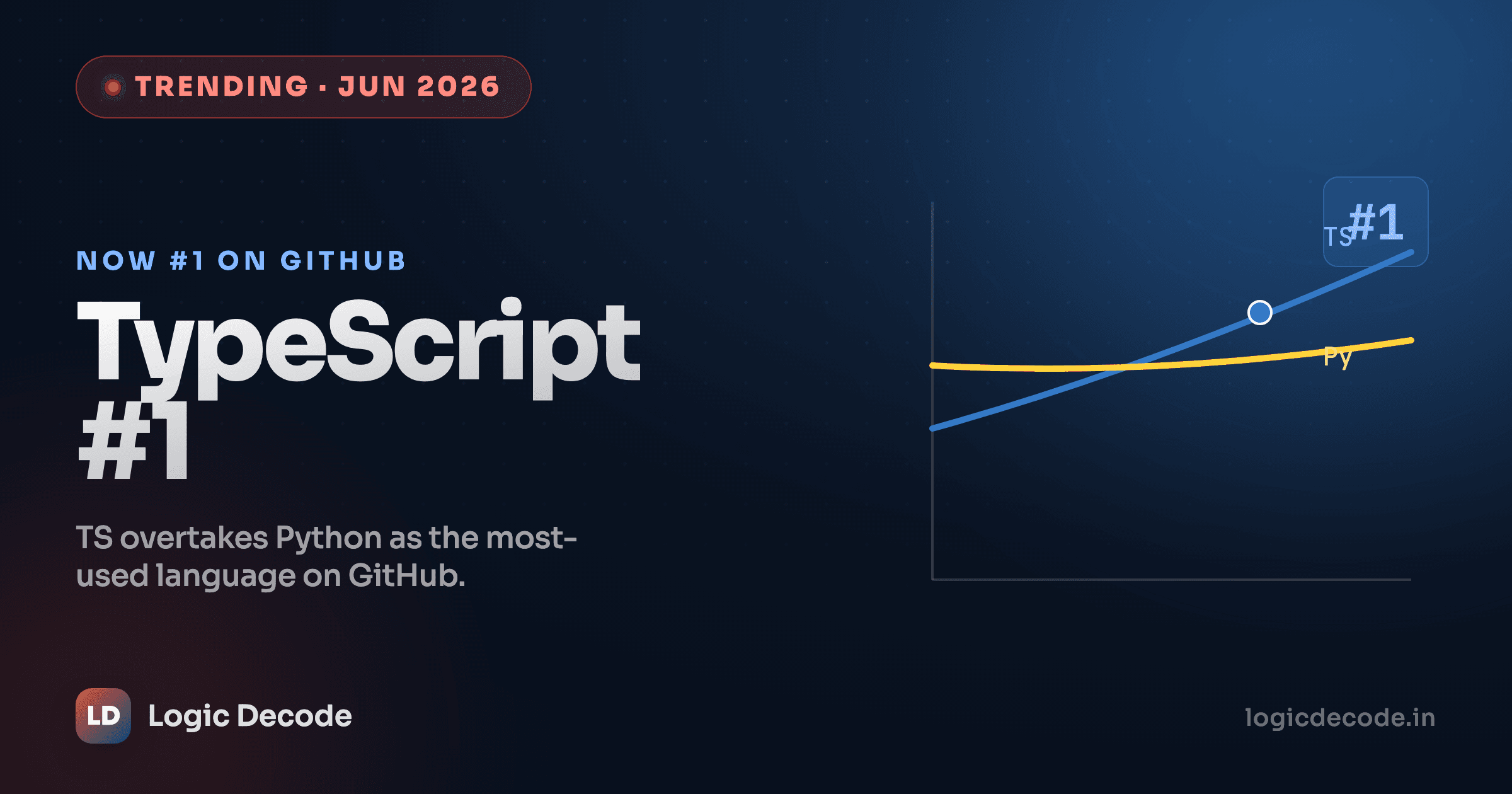
A language nobody had heard of fifteen years ago is now the busiest one on the largest code host on the planet. In August 2025, TypeScript finished the month with 2,636,006 monthly contributors and edged Python out by roughly 42,000 developers, according to GitHub's Octoverse 2025 report. Python had held the top spot for 16 straight months. Now it's second.
That's the headline. It's also the least interesting part.
The numbers, briefly
The growth is what makes you sit up. TypeScript added more than a million contributors in a single year, a 66.6% jump. Python wasn't crawling either. It grew 48% and added around 850,000 people. JavaScript added another 427,000 (about 25%). So this isn't a story of Python collapsing. Everything is up and to the right, because GitHub itself is exploding: 36.2 million new developers joined in 2025, which works out to roughly one new developer every second.
| Language | Monthly contributors (Aug 2025) | YoY growth |
|---|---|---|
| TypeScript | 2,636,006 | +66.6% |
| Python | ~2.59M | +48% |
| JavaScript | ~2.15M | +25% |
TypeScript didn't win by standing still while Python tripped. It won by growing faster than a language that was already on a tear. When the runner-up is putting up 48% and you still pull ahead, something structural is going on.
So what's the structural thing?
Three forces, and they reinforce each other.
The first is boring and has been true for years: every serious web framework now hands you TypeScript whether you asked for it or not. Spin up a new Next.js, Astro, or SvelteKit project and you get a .ts codebase by default. A huge share of those 2.6 million contributors never made a "language choice" at all. They ran a scaffold command and TypeScript came out. Defaults are the quietest, strongest force in software, and TypeScript has owned the defaults for a while.
The second force is the one everyone's talking about, and for once the hype is pointing at something real: AI-assisted coding rewards types.
Here's the mechanism, and it's worth getting right because it's usually hand-waved. When a model writes code for you, you need a fast, cheap way to tell whether the code is garbage. In an untyped language, "is this correct?" often means running it and seeing what blows up. In a typed language, the compiler answers a big chunk of that question before the code ever runs. Wrong shape passed to a function, a property that doesn't exist, a string where a number should be. The type checker flags it in milliseconds, right in your editor, with a red squiggle. GitHub's own writeup put it plainly: statically typed languages give you guardrails, and when a tool is generating code for you, you want a fast way to know whether that code is correct.
A study cited in the report found that the overwhelming majority of compilation errors in LLM-generated code were type-check failures. Read that twice. The single most common way AI-written code breaks is by getting types wrong, exactly the failure a type checker exists to catch the instant it happens. Types aren't fighting AI. They're the seatbelt.
Types as a tighter feedback loop
The win isn't "types catch bugs" in the abstract. Every TypeScript advocate has said that for a decade. The win is speed of feedback. A type error surfaces in your editor before you run anything. When a model is generating dozens of lines you didn't write, a sub-second "this is wrong, here's where" beats discovering it three function calls deep at runtime.
The third force is the sneaky one, and it's why this lead probably sticks. Models get better at whatever they've seen most. Train on a trillion examples of TypeScript and a few thousand of some niche language, and the model is simply going to write better TypeScript. More TypeScript on GitHub means better AI completions for TypeScript, which makes more people reach for TypeScript, which puts more of it on GitHub. GitHub called this a feedback loop, and InfoQ described the same thing as a convenience loop reshaping language choice. Whatever you name it, it's a flywheel, and TypeScript is already spinning it.
This isn't a TypeScript thing. It's a type-safety thing.
Zoom out and the same pattern shows up everywhere, in languages that have nothing to do with the web.
Rust keeps eating into C and C++ for the parts where memory bugs are expensive. The Linux kernel moved Rust support out of "experimental" and made it permanent in late 2025, and Greg Kroah-Hartman has said Rust drivers are proving safer than the C equivalents. The White House pushed memory-safe languages by name. Nobody's deleting C. They're adding Rust where the compiler's guarantees pay for themselves.
On Android, Kotlin didn't just beat Java, it lapped it. New Android projects start in Kotlin well over 90% of the time, and Jetpack Compose ships with no Java API surface at all. The headline Kotlin feature? Null safety baked into the type system, so the null pointer exception (Java's most reliable way to crash an app at 2am) becomes a compile error instead.
TypeScript over JavaScript. Rust over C and C++. Kotlin over Java. Three different ecosystems, three different decades of baggage, one common move: push more correctness checking to compile time, before the code ever runs in front of a user. The AI wave didn't start this trend. It poured gasoline on it.
Quick check
Per the Octoverse 2025 data, why did TypeScript overtake Python, not just rank #1?
Don't read this as Python losing
Here's where the takes online go wrong. A pile of them framed this as Python getting dethroned, like there's a loser. There isn't.
Python slid to #2 on a metric (total monthly contributors across all of GitHub) that lumps a college student's first print("hello") in with a kernel maintainer. By that measure, sheer web-developer headcount was always going to swing it. But the metric that matters to a Python person didn't move: Python still owns machine learning, data science, and model training outright. The libraries are there, the researchers are there, the notebooks are there, and none of that is migrating to TypeScript any time this decade. GitHub's own framing said it cleanly. TypeScript isn't winning against Python. Each is winning where it's the right tool.
Think of it as two races, not one. TypeScript is winning "what most people on GitHub touch day to day." Python is winning "what the AI revolution is actually built out of." The models writing all that TypeScript? They were trained, fine-tuned, and served by stacks that are Python from top to bottom.
What to actually learn in 2026
If you came here for "should I learn TypeScript or Python," the honest answer is the annoying one: it depends on what you want to build. But I'll give you a real recommendation instead of a shrug.
If you want to build things people open in a browser or on their phone (products, apps, dashboards, tools) learn JavaScript first to understand the runtime, then go straight to TypeScript and don't look back. The defaults, the jobs, and the AI tooling are all pulling the same direction, and that's not changing. Start with the language fundamentals in JavaScript for Beginners, then move into TypeScript for Beginners the moment your projects get big enough that "wait, what shape is this object" becomes a real question. (It happens faster than you'd think.)
If you want to work on AI, data, models, automation, or scientific computing, learn Python. Its #2 ranking changes nothing about its grip on that world. And if you end up doing both, building an AI product with a TypeScript front and a Python brain, congratulations, you've just described where a large share of 2026's interesting work actually lives.
The deeper lesson sits above any single language. The industry is voting, with millions of repos, for moving correctness checks earlier: to compile time, into the editor, ahead of the user. Whatever you pick, lean into the tools that tell you you're wrong before you ship. That instinct will outlast every language ranking, including this one.
Octoverse 2026 lands this fall. My bet: TypeScript holds the top, Python holds AI, and the type-safety drift keeps grinding forward in every corner of the stack. Check back and hold me to it.

Written by
Rhythm Bhiwani
Engineer and relentless builder, happiest reverse-engineering hard problems until they click.
Enjoyed this?
Tap the heart to leave some love.
Be the first to react
Comments
Join the conversation.
Loading comments…