Microsoft Is Quietly Swapping the AI Inside Copilot
Microsoft now routes Excel and Outlook Copilot prompts to its own MAI models instead of OpenAI and Anthropic. What the quiet swap means for builders.

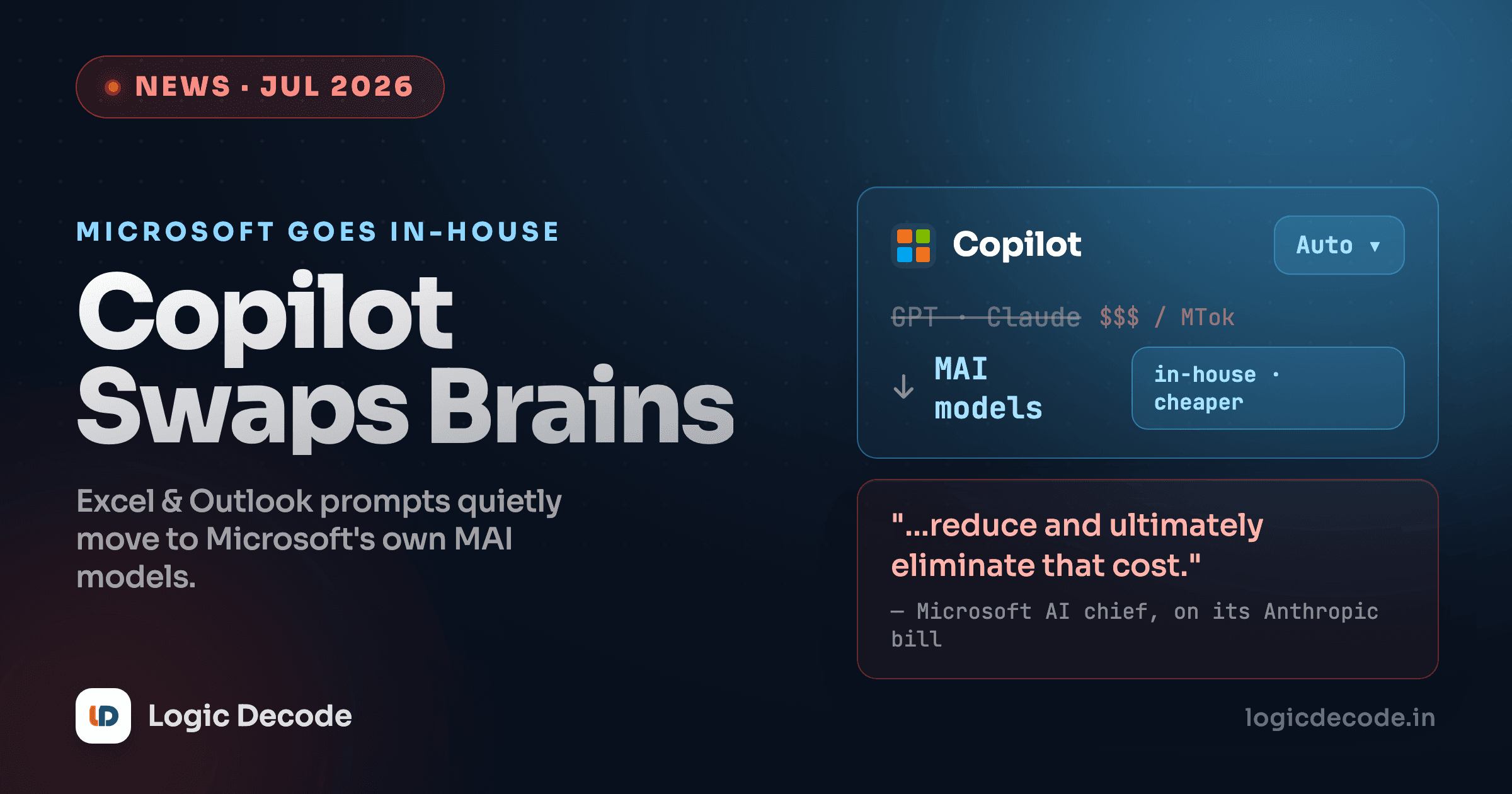
Bloomberg reported on Monday that Microsoft has started replacing OpenAI and Anthropic models with its own MAI models inside Excel and Outlook. No announcement, no changelog entry, no new button. Tens of thousands of Copilot prompts a week are now answered by Microsoft's in-house models, and users have no way to tell. The swap itself is small. What it signals is not.
What Microsoft actually changed
Per the Bloomberg report (covered without the paywall by The Decoder), Microsoft's MAI family now completes tens of thousands of AI prompts per week in Excel and Outlook. That's a rounding error next to Copilot's total traffic, and OpenAI and Anthropic models still handle most of the work. But the direction is explicit. The in-house models are set to expand into GitHub Copilot and Teams next, and a MAI coding model, MAI Code 1 Flash, is already selectable in GitHub Copilot.
The models come from the batch Microsoft announced at Build in June. Seven of them, including one the company says matches Claude Opus 4.6 on coding at a lower cost. Independent numbers are thinner than the claims. The Decoder places MAI-Thinking 1 roughly level with DeepSeek V3.2 and behind Anthropic's Sonnet 4.6 and Opus 4.6.
That gap matters less than it looks. Nobody at Microsoft is claiming MAI models are frontier, because they don't have to be. "Summarize this email thread" and "explain this formula" are not frontier problems, and that's exactly the work Excel and Outlook generate at enormous volume.
Why Microsoft is doing it
The motive is on the record. Microsoft's AI chief Mustafa Suleyman said in June that the company's goal is to "reduce and ultimately eliminate" what it pays Anthropic. OpenAI bills Microsoft at partnership discount rates. Anthropic doesn't. So Anthropic traffic is the expensive line item, and the first one on the chopping block.
Run the numbers from Microsoft's side. Copilot sits inside Word, Excel, Outlook, PowerPoint and Teams for hundreds of millions of users, and every prompt routed to a third-party frontier model is margin leaving the building. A model that's 80% as capable at a fraction of the cost wins every workload where 80% is enough. This is the same math that pushed startups toward cheap open-weight models in the 2026 price war, just executed by the world's largest software company against its own partners.
The Auto button is doing more than you think
The part I find genuinely interesting is how invisible this is from the user's chair. Office Watch notes that nothing in the interface changed. The Copilot button looks identical, the "Auto" model selection quietly routes some requests to MAI instead of GPT or Claude, and there is no setting that shows you which model answered.
Two consequences fall out of that routing box. The same prompt can produce different results on different days, because a different model may answer it. And "Auto" gives Microsoft a dial it can turn without shipping anything, shifting more traffic in-house as MAI improves or routing it back if quality complaints pile up.
How solid is this reporting?
The story traces back to one Bloomberg piece citing people familiar with the matter, echoed by the outlets above. Microsoft hasn't published its own numbers. Treat the specifics (which apps, how many prompts) as directional rather than audited. The firmly on-the-record part is Suleyman's stated goal of eliminating the Anthropic bill.
If you build with LLMs, copy the move
Watch what Microsoft does, not what any lab's marketing says. The biggest AI product in the world just treated frontier models as swappable parts. That should settle a few arguments on your team.
Keep model choice in config. If swapping models means a refactor, the architecture is wrong. The swappable client pattern is three environment variables plus an eval set, and it's the whole reason Microsoft can move Excel to a new model without users noticing. The model was never hard-wired in.
Route by task, not by loyalty. An email summary doesn't need the model that wins math olympiads. Send the boring 80% of your traffic to the cheapest model that clears your quality bar, and spend frontier money only on requests that earn it. There's a full routing walkthrough for picking when to pay.
And if you're on the other side of this, building on top of Copilot or any AI feature you don't control, assume the brain can change under you without notice. A workflow that behaved one way in June can behave differently in August because a different model now answers the prompt.
Quick check
Your team runs an internal workflow that depends on Copilot output. After this news, what protects you best?
What to watch next
The near-term tells are concrete. Does MAI Code 1 Flash usage grow inside GitHub Copilot? Does Teams transcription flip to the in-house model? Does "Auto" split into a cheap default with frontier models as a paid upgrade, a pricing shape The Decoder floats as the likely endgame? The bigger one is the OpenAI relationship itself. Those discount rates have an expiry, and the whole MAI program reads like Microsoft preparing for the day the discount runs out.
One takeaway survives every scenario here. Models are becoming plumbing. The interesting question stopped being which lab leads this month and became whether your stack lets you act on it when the answer changes. Microsoft wired for the swap years in advance. Do the same.

Written by
Rhythm Bhiwani
Engineer and relentless builder, happiest reverse-engineering hard problems until they click.
Enjoyed this?
Tap the heart to leave some love.
Be the first to react
Comments
Join the conversation.
Loading comments…