Nvidia Buys Hugging Face for $12.9B: What Changes for You
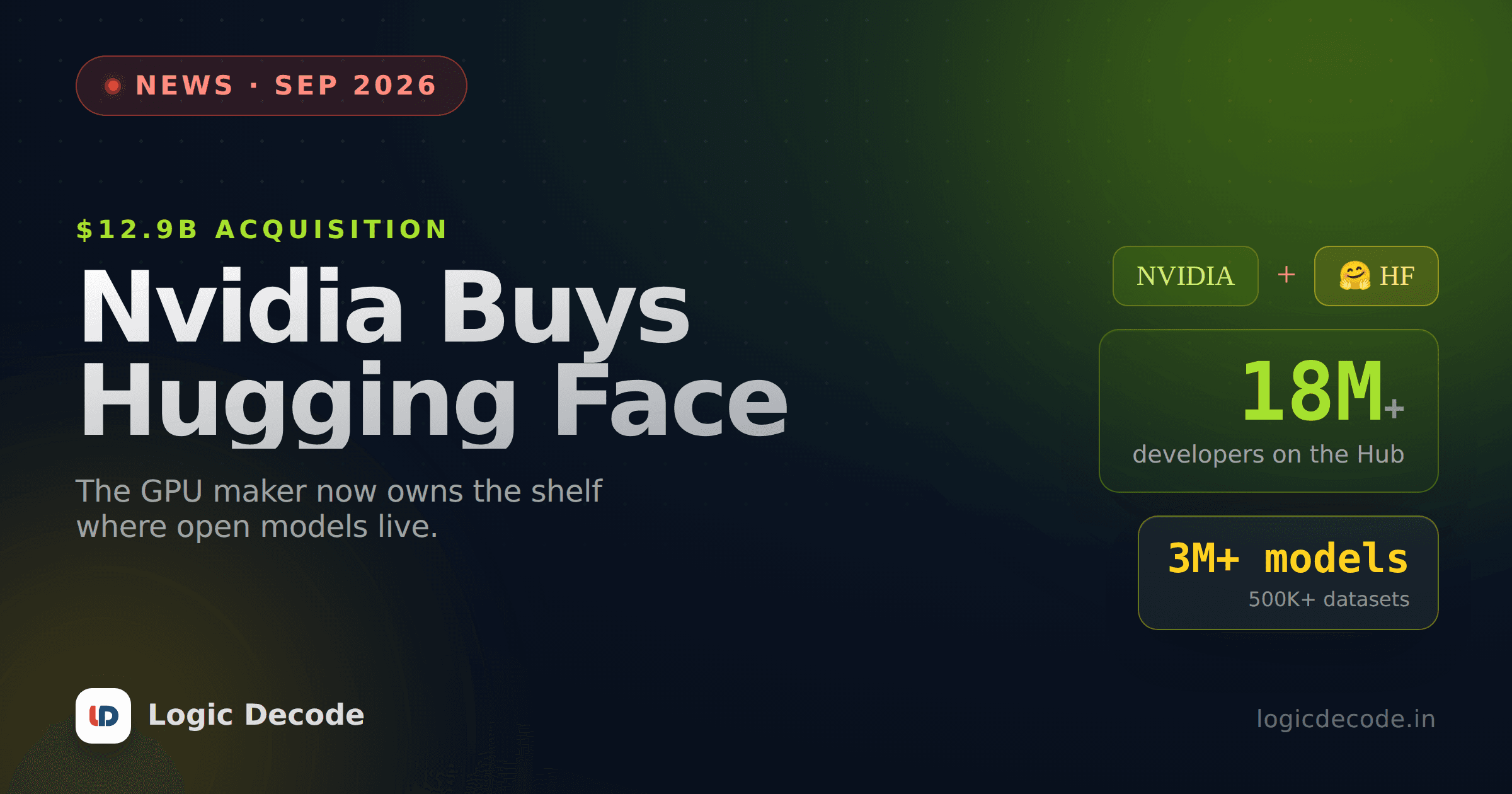
Nvidia is acquiring Hugging Face, the biggest hub for open-source AI models, for $12.9 billion. Here's the deal, the neutrality concerns, and what to actually do about it.

If you've ever run pip install transformers or pulled a model off the Hub, you've used infrastructure that was, by design, nobody's. Hugging Face wasn't owned by a model lab or a cloud giant. It was the shared library everyone used and nobody controlled. That changed on September 2, when Nvidia signed a deal to buy it for $12.9 billion.
The GPU maker that already sits underneath almost every training run in the industry is now buying the shelf where the finished books get published. Let's get the facts straight, then talk about whether that's a problem.
The deal in one breath
Nvidia's agreement values Hugging Face at $12.93 billion: about $11.9 billion paid to shareholders, plus roughly $1 billion in retention equity for Hugging Face employees who join Nvidia. It's Nvidia's largest acquisition ever, by a wide margin.
| Detail | What we know |
|---|---|
| Buyer | Nvidia |
| Target | Hugging Face |
| Price | ~$12.93B ($11.9B to shareholders + ~$1B employee retention) |
| Announced | September 2, 2026 (8-K filed with the SEC) |
| Expected close | First half of 2027, pending regulatory approval |
| Hugging Face scale | 18M+ developers, 3M+ models, 500K+ datasets, 1M+ apps |
CNBC reported Nvidia was closing in on the deal in late August, and Hugging Face's own CEO later told CNBC that his team had approached Jensen Huang weeks before the announcement. This wasn't an unsolicited buyout. Hugging Face went looking for this.
That matters, because it reframes the story. This isn't Nvidia strong-arming the open-source commons. It's a company that runs on donated compute and thin margins deciding the best way to survive at 18 million users is to sit inside the balance sheet of the company that makes the chips everyone on that platform already needs.
Why Nvidia wants the shelf, not just the factory
Nvidia sells GPUs. Its real risk isn't losing the hardware race this year, it's losing visibility into what happens next: which architectures get built, which formats become standard, which runtime everyone quietly assumes they'll deploy to. Hugging Face sees that activity before almost anyone else does, because that's where people upload the models, publish the benchmarks, and ship the demos.
Owning the Hub gives Nvidia three things at once: a front-row seat on where the field is heading, a natural on-ramp to push its own inference stack (TensorRT, NIM, CUDA-tuned builds) as the default rather than one option among several, and a moat under the price war that's already crushing inference margins. If the Hub nudges people toward Nvidia-shaped deployment by default, that's demand Nvidia doesn't have to win on price.
None of that requires banning anything. It just requires being the thing that loads fastest, gets featured, and works out of the box.
The neutrality problem, stated plainly
Hugging Face functioned less like a vendor and more like shared infrastructure. Anthropic, Google, Meta, and a thousand two-person startups all published to the same neutral shelf, and researchers trusted it partly because no single lab or cloud provider stood behind it. That's the thing a $12.9 billion price tag buys, and it's also the thing that's genuinely at risk.
The realistic worry isn't Nvidia deleting AMD-optimized models or blocking competitors from the Hub. It's quieter than that: a search page that surfaces Nvidia-tuned checkpoints first, a "recommended runtime" that's always TensorRT, a Spaces tier that runs noticeably better on Nvidia inference. Nothing here breaks a rule. It's just gravity, applied by the owner of the shelf, and it compounds over years the way this kind of thing always does.
The counterargument, fairly stated
The core libraries, transformers and diffusers, are open source and can be forked. Models on the Hub carry their own licenses independent of who owns the platform. And Nvidia has publicly said Hugging Face stays an open platform for the whole ecosystem, not just Nvidia customers. Whether that promise holds is a five-year question, not a five-week one.
What actually changes for you this week
Nothing. The deal doesn't close until the first half of 2027, and it still needs regulatory sign-off, which is not a formality for a chipmaker this dominant buying the biggest distribution point for the thing it sells. Antitrust regulators in the US and EU have both gotten more willing to look hard at AI infrastructure deals over the past two years.
What's worth doing now is the same hygiene that mattered before this deal and will matter after it closes:
- Don't build on a single point of distribution. If a model or dataset is load-bearing for your product, know where else it lives, or mirror it yourself. Hugging Face isn't going away, but "the only place I can get this" is a bad place to be regardless of who owns it.
- Keep your inference stack portable. If you've standardized on
transformersand open formats like safetensors, you're already in a good spot. Watch for the moment a "recommended" path starts meaning "only well-supported" path. - Read the platform terms when they update. They will update, probably around the close. That's when to check what changed for hosted inference, private repos, and enterprise data handling.
Quick check
What's the most realistic way this acquisition could hurt an open-source AI developer, based on what's actually in the deal?
The pattern this fits
This is the same consolidation playing out across AI tooling this year. SpaceX bought Cursor to fold a neutral coding front-end into xAI's model stack. Now the company that makes the GPUs is buying the neutral shelf where open models live. The independent, vendor-agnostic layer keeps getting expensive enough that the vendors it stayed neutral from can just buy it.
It's also worth remembering Hugging Face had a rough year on the security side too, after an AI agent breached part of its production infrastructure in July. None of that is connected to this deal, but it's a reminder that "the neutral commons" was already carrying real operational weight for a company its size. Nvidia's balance sheet solves that problem. It just introduces a different one.
The bottom line
Hugging Face asked for this, Nvidia's money keeps a strained infrastructure company alive, and nothing changes on your screen for at least a year. The thing to actually track isn't a headline event, it's the slow stuff: what gets featured, what runs best by default, what "recommended" quietly starts to mean. Keep your models and your deployment path portable, and you'll be fine regardless of how this plays out.
Sources: Nvidia's official announcement, TechCrunch's confirmation coverage, CNBC on the deal talks, and Nvidia's SEC 8-K filing.

Written by
Rhythm Bhiwani
Engineer and relentless builder, happiest reverse-engineering hard problems until they click.
Enjoyed this?
Tap the heart to leave some love.
Be the first to react
Comments
Join the conversation.
Loading comments…