SpaceX Buys Cursor for $60B: What It Means for Devs
SpaceX is acquiring Cursor for $60 billion in all-stock, folding the AI code editor into xAI. Here's what the deal actually means for the people who use it.

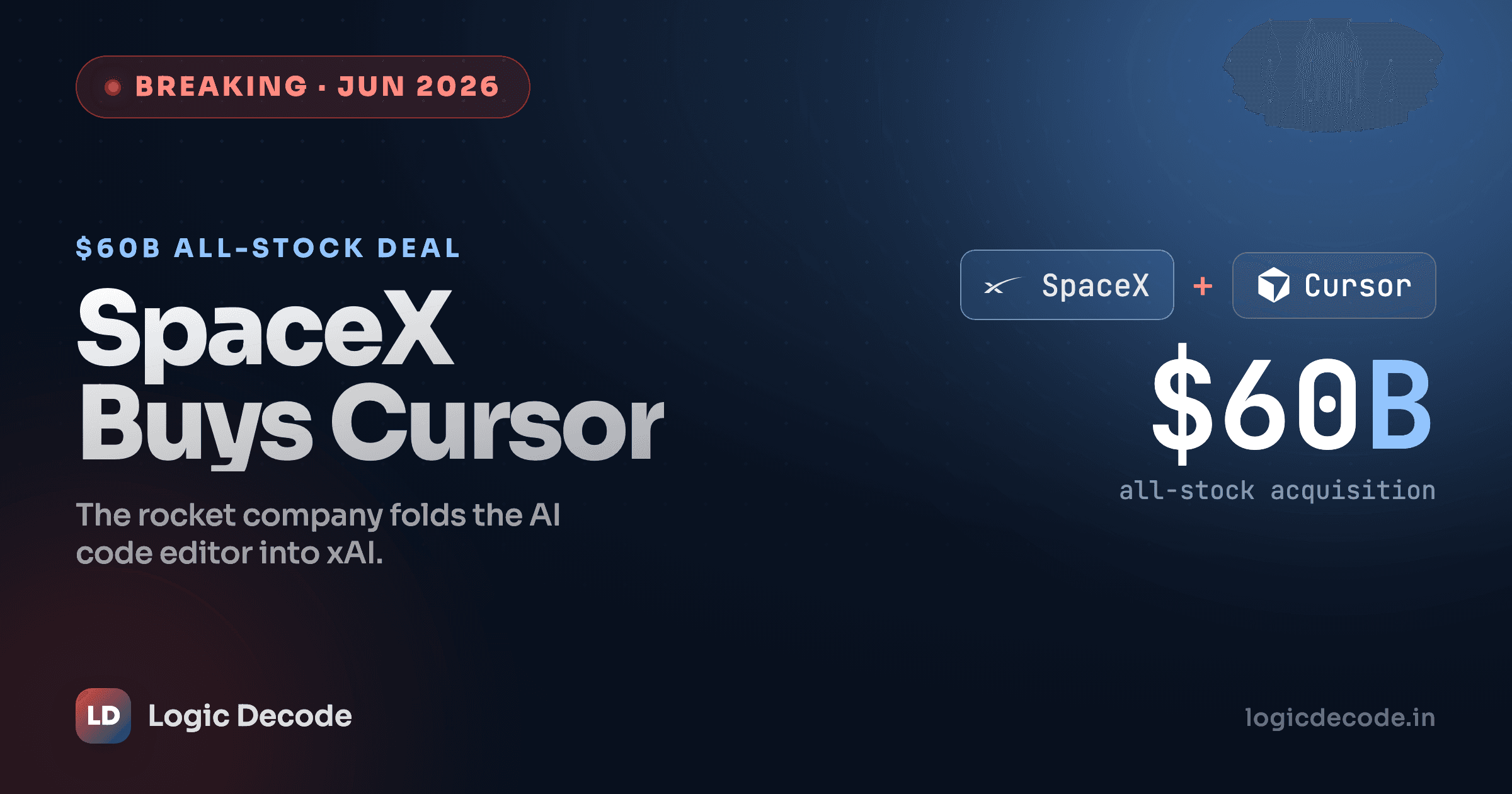
A rocket company now owns one of the most popular code editors on the planet. That sentence shouldn't parse, and yet here we are: SpaceX is buying Cursor for about $60 billion in stock, and the paperwork hit the SEC today.
If you've been using Cursor to write code, the tool didn't change this morning. The company behind it did. That distinction is the whole story, so let's get the facts straight and then talk about what it means for your editor, your code, and the broader squeeze happening across AI tooling.
The deal in one breath
SpaceX agreed to acquire Anysphere (the startup that makes Cursor) in an all-stock transaction that values the company at roughly $60 billion. The merger runs through a SpaceX subsidiary, and Cursor shareholders get SpaceX Class A stock in exchange, with the conversion ratio pinned to SpaceX's volume-weighted price over the seven trading days before the deal closes. Both sides expect it to close in the third quarter.
This wasn't a surprise sprint. Back in April, SpaceX took out an option: pay around $10 billion for a deep training partnership, or buy the whole company for $60 billion later in the year. Four days after SpaceX's record-setting IPO on June 12, it picked the second door.
| Detail | What we know |
|---|---|
| Buyer | SpaceX (which merged with xAI earlier in 2026) |
| Target | Cursor, made by Anysphere |
| Price | ~$60 billion, all stock |
| Structure | Merger via a SpaceX subsidiary, with Cursor stock converting to SpaceX shares |
| Filed | June 16, 2026, with the SEC |
| Expected close | Q3 2026 |
The numbers under the hood explain the price tag. Cursor crossed a billion dollars in annualized revenue during 2025 and, by reporting earlier this year, was running near $2 billion, one of the steepest revenue ramps software has ever seen, off a product that barely existed in 2022. You don't pay $60 billion for a text editor. You pay it for a few million developers who open that editor every morning.
Why a rocket company wants your code editor
The short answer: SpaceX isn't really the buyer here, xAI is. The two merged earlier this year, so SpaceX's balance sheet and freshly public stock are now the war chest for Elon Musk's AI ambitions. And xAI has a gap. OpenAI ships Codex, Anthropic ships Claude Code, and both have turned coding into one of the stickiest, highest-value uses of a frontier model. Grok hasn't had an answer that developers actually reach for.
Buying Cursor closes that gap in one move. It hands xAI distribution (all those daily-active developers), a revenue engine, and a front-end that can route work to Grok instead of to Anthropic's or OpenAI's models. On the back end, Cursor gets pointed at Colossus, xAI's enormous Memphis data center, for training and inference. The pitch writes itself: a top-tier editor, fed by one of the largest compute clusters in the world, owned by the same company.
Strategically it's clean. Whether it's good for you depends on which side of that loop you sit on.
What actually changes for people who use Cursor
Nothing, this week. Deals like this close in months, and the team has every incentive to keep the product steady while the ink dries. The questions worth holding in your head are about the next year, not the next sprint.
The model backend is the thing to watch. Cursor's strength has always been that it was model-agnostic. It would happily drive Claude, GPT, or Gemini, and you picked what worked. An owner with its own frontier model has an obvious incentive to make Grok the default and the cheapest path, and to make everyone else a second-class citizen over time. Maybe that happens slowly, maybe it doesn't happen at all, but the incentive now points one direction it didn't before.
Your code is the training-data question. You're already sending your codebase to a model provider when you use any AI editor. That's the deal. What changes is who that provider is and what their data posture looks like. If your company has rules about where source code can go, "owned by xAI, trained on Colossus" is a new line item for your security team, not a footnote. Read the data terms when they update. They will update.
The roadmap now serves a bigger agenda. Cursor used to optimize for one thing: making developers productive enough to keep paying. It still wants that, but it now also has to make Grok look good and feed a parent company's strategy. Most of the time those goals align. When they don't, you're no longer the only customer in the room.
Don't panic-migrate
A signed merger is not a closed merger, and a closed merger is not a worse product. Cursor is still Cursor today. The right move isn't to flee. It's to make sure you could leave without a rewrite. That's just good hygiene regardless of who owns your tools.
The real trend: the IDE is becoming a lab feature
Step back and this isn't a one-off. It's the same consolidation hitting the whole AI coding-tool space. OpenAI has Codex. Anthropic has Claude Code. Google folds coding into Gemini. Now xAI has Cursor. The independent AI editor, the neutral layer that would route your work to whichever model was best that month, is being absorbed into the model labs one acquisition at a time.
That's rational for the labs and a little worrying for the rest of us. The neutral layer was where price competition lived. When your editor and your model come from the same company, the gentle pressure that a brutal model price war puts on everyone gets a lot easier to sidestep. Bundling is how you stop competing on price.
Quick check
What's the single biggest practical risk this deal creates for a developer who relies on Cursor?
What I'd do
Keep your workflow swappable. If Cursor is your daily driver, great, keep using it, but make sure your actual leverage (your prompts, your habits, your project setup) isn't welded to one vendor. Try a terminal-native agent alongside it so switching costs stay low. Keep an eye on the model picker. The day Grok quietly becomes the default and the others get worse, you'll want options already warmed up.
This is the consolidation a lot of us saw coming. The editor layer was too valuable and too neutral to stay independent, and $60 billion is what neutrality costs when a model lab decides it wants the front door too. Cursor's a great tool. Just don't let any great tool become the only one you know how to use.
For the primary reporting, see CNBC, TechCrunch, and Bloomberg.

Written by
Rhythm Bhiwani
Engineer and relentless builder, happiest reverse-engineering hard problems until they click.
Enjoyed this?
Tap the heart to leave some love.
Be the first to react
Comments
Join the conversation.
Loading comments…