The 2026 AI IPO Wave: What Going Public Signals
OpenAI and Anthropic confidentially filed for IPOs and SpaceX raised $75B. What AI labs going public means for developers who build on their APIs.

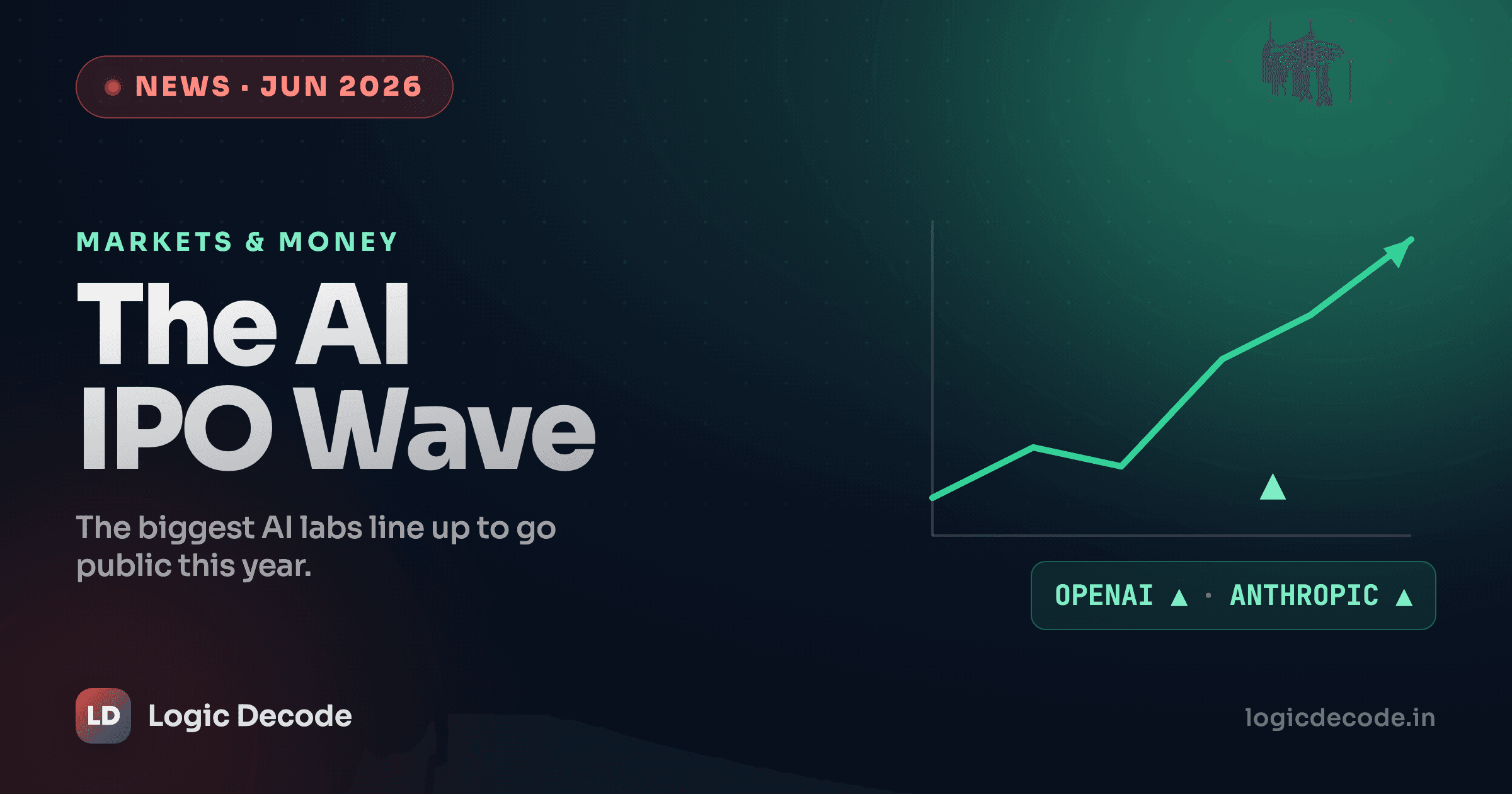
The companies whose APIs sit in your .env file are about to get shareholders. That's the part of the 2026 IPO rush nobody's framing correctly for the people it actually affects. The headlines are all valuations and Musk's net worth. The thing that matters if you've got a production app calling Claude or GPT is quieter: the labs you depend on are trading the patience of a handful of private backers for the quarterly judgment of the public market. Different incentives. Different failure modes. And it's happening in a window of about three weeks.
What actually happened, and what didn't
Let's get the facts straight first, because "filed for an IPO" is doing a lot of vague lifting in most coverage.
Anthropic confidentially filed a draft S-1 with the SEC on June 1, fresh off a $65B raise that put it at a $965B valuation. A week later, on June 8, OpenAI did the same, last marked around $852B. Both submissions are confidential, and that's a real legal status, not marketing. It lets a company start the SEC review privately, keep its financials off the public record for now, and bail without anyone seeing the numbers if the market turns. Neither has priced. Neither has set a firm date. OpenAI was explicit that timing is open and some things are "easier as a private company." So: filed, yes. Going public next week, no.
SpaceX is the one that actually crossed the line. It priced at $135 a share on June 11 and debuted June 12 under the ticker SPCX, raising about $75B at roughly a $1.75T valuation, the largest IPO in history, tripling Saudi Aramco's 2019 record. It then popped about 19% on day one to close near $161, briefly pushing the company past $2T. SpaceX isn't an AI lab, but it's the proof-of-appetite that makes the AI filings credible: public markets will swallow a giant, money-losing, AI-adjacent moonshot ($18.7B in 2025 revenue, a $4.9B net loss) without flinching.
And the megacaps are funding the buildout in plain sight. Alphabet announced an $80B-plus equity raise on June 1 (upsized past $84B, including a chunk from Berkshire Hathaway) purely to pay for AI compute, on top of capex guidance now running $180B–$190B for 2026 alone.
| Company | Status (16 Jun 2026) | Valuation / Raise |
|---|---|---|
| SpaceX | Priced & trading (SPCX, 12 Jun) | ~$1.75T val · $75B raised |
| Anthropic | Confidential S-1, ~Oct target | $965B (private) |
| OpenAI | Confidential S-1, timing open | ~$852B (private) |
| Alphabet | Equity raise, completed | $84B+ raised for AI capex |
Filing status is not pricing
"Confidentially filed" means the SEC review has started privately. It is not a price, a date, or a commitment to list. Treat the OpenAI and Anthropic numbers as last private marks, not IPO prices. Those don't exist yet, and the companies can still pull the filings.
Here's the timeline, because the order matters
The sequencing tells you this is a wave, not four unrelated events. CoreWeave's 2025 debut and its run-up since gave Wall Street the template: heavy capex is fine if revenue compounds. Once that worked, the floodgate logic kicked in.
The end of the infinite-private-money era
For most of the last decade, frontier AI ran on a specific cheat code: private capital with no quarterly clock. SoftBank, Microsoft, a16z, sovereign funds, money that would tolerate a $5B loss because the upside was civilizational, and nobody had to explain a margin to a retail investor in 90-day increments. That model let labs price compute below cost, eat the loss, and call it land-grab.
An IPO ends that, slowly. Public companies file 10-Qs. They hold earnings calls. They get analysts modeling their gross margin on inference and asking, on the record, when the API business stops bleeding. That's not a side effect of going public. It is going public. The whole point of a confidential filing is to start getting your house presentable for exactly that scrutiny.
I read this as maturity, mostly. A market that prices these companies forces a question the private rounds let everyone dodge: is there a real business here, or just a very expensive demo? SpaceX answered it loudly. Investors bought a money-losing rocket company at $2T because Starlink's a real, growing, profitable segment. The AI labs will have to make the same case in writing, and "we'll figure out monetization later" reads very differently in an S-1 than in a pitch deck.
What it means if you build on these APIs
This is the part for us. Strip away the finance-bro coverage and ask the only question that matters to someone shipping software: does my dependency get better or worse when its provider answers to shareholders?
Both, and it depends entirely on which pressure wins.
The optimistic read: discipline. Public companies can't burn forever. A lab under earnings pressure has a strong reason to ship reliable APIs, hit its SLAs, stop deprecating endpoints on a whim, and treat paying developers like the revenue line they are, because on the next call, that revenue line is the story. Stability becomes a feature management actually cares about.
The pessimistic read: enshittification with a fiduciary excuse. That same pressure is exactly how good products get squeezed. Quarter-over-quarter growth demands either more users or more dollars per user. When user growth flattens, the screws turn on the people already locked in. That's you, with six months of prompts tuned to one model's quirks. Price hikes get defended as "delivering shareholder value." The free tier shrinks. Rate limits arrive on the model you standardized on. None of it is malice. It's just what the incentive structure rewards once the growth story needs a new chapter.
The hedge is the same as it always was
Whichever way the incentives break, the protection doesn't change: don't hard-wire your app to one vendor. Keep model choice and prompts in config, keep an eval set, and rehearse the swap. A public lab that raises prices is a config change for a prepared team and a crisis for an unprepared one.
And then there's the bubble question, which you can't honestly skip. SpaceX trading at something like 90x sales. Four hyperscalers committing over $700B in combined 2026 capex. Labs filing at near-trillion-dollar marks while still losing money on the core product. Some of this is real demand finally getting financed at scale. Some of it is momentum money chasing a narrative, and a chunk of these valuations assumes a future that has to actually arrive. I don't know which slice is which, and neither does anyone claiming certainty in either direction.
But here's the thing about a bubble from a builder's seat: it's mostly an investor problem until it becomes a supplier problem. If the financing dries up, the labs that priced inference below cost to grab share suddenly can't. That's when "cheap frontier API" gets repriced toward what it actually costs to serve, and your unit economics, quietly built on subsidized tokens, get a surprise.
Quick check
An AI lab you depend on goes public and beats earnings two quarters running. What's the most likely medium-term effect on you as a paying developer?
My actual stance
Going public is good for the industry and neutral-to-risky for you specifically, and the difference is entirely about whether you've made yourself swappable.
For the industry, it's healthy. The infinite-runway era let everyone avoid the question of whether frontier AI is a business. Public markets force the answer, and forced answers beat indefinite hand-waving. Disclosure, scrutiny, real margins on the record. That's how you tell the durable companies from the ones running on narrative.
For you, none of it changes the one thing under your control. A lab that files an S-1 is a lab whose incentives are about to tilt toward its shareholders and away from your convenience, gradually, in ways that look reasonable on every individual earnings call. The teams that come out ahead aren't the ones who picked the "right" lab. That bet's unknowable. They're the ones who treated every provider as replaceable from day one. If you've got an eval set and switching models is a config flag you've actually tested, the IPO wave is just market news you read with coffee. If your whole app is welded to one vendor's exact behavior, it's a slow-motion risk you took on without noticing. We walk through building exactly that kind of swappable setup in the build-with-llms series, and the tokens, cost, and safety lesson covers measuring the trade-offs that public-company pricing will eventually force.
Watch the filings. But spend your energy on portability. The companies are going public. Make sure your code doesn't have to care.

Written by
Rhythm Bhiwani
Engineer and relentless builder, happiest reverse-engineering hard problems until they click.
Enjoyed this?
Tap the heart to leave some love.
Be the first to react
Comments
Join the conversation.
Loading comments…