AI's Real Bottleneck in 2026 Is Power, Not the Models
AI's binding constraint in 2026 isn't model quality. It's electricity, grid capacity, and chips. What that means for developers shipping real apps.

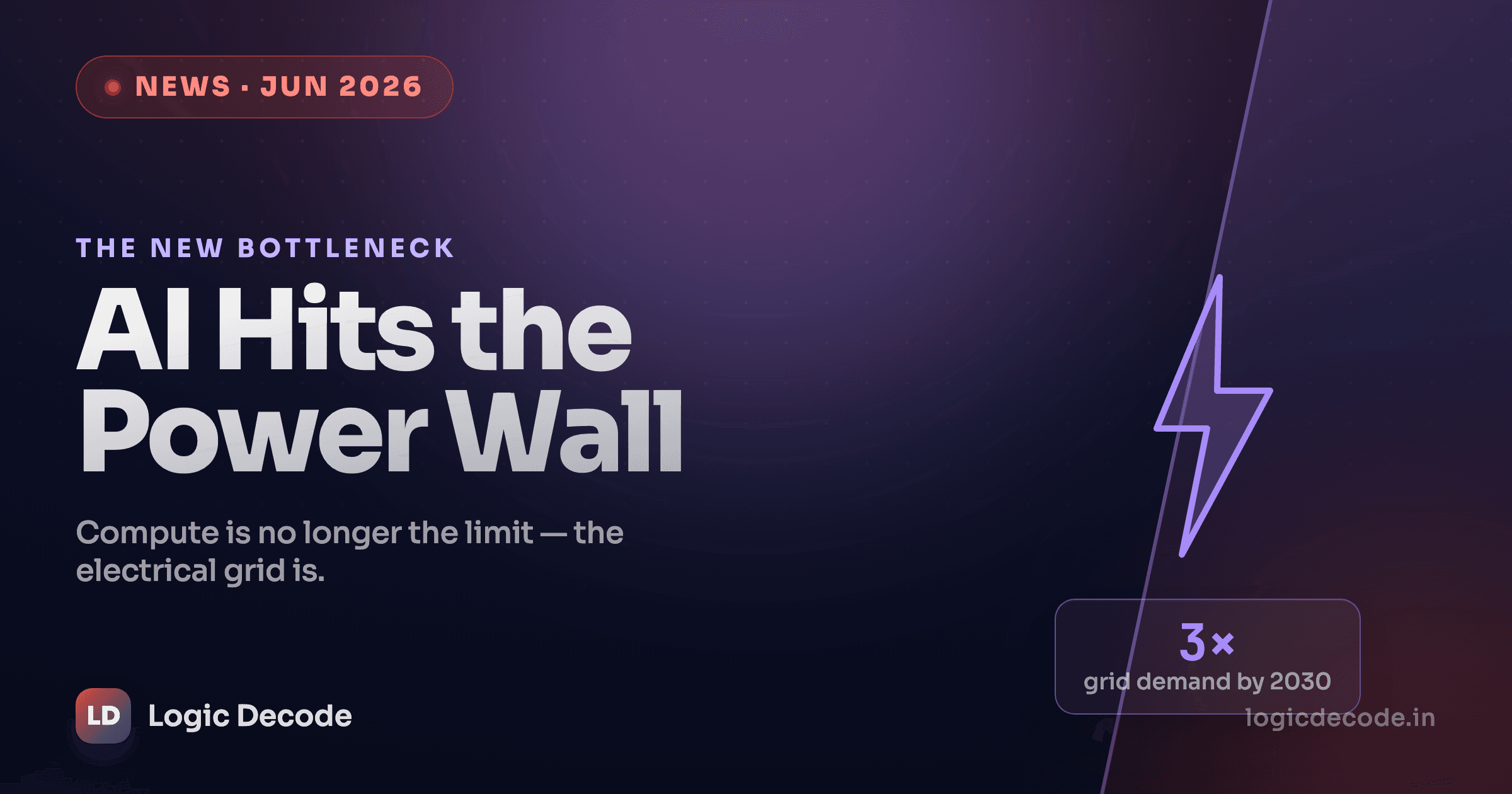
For about three years the interesting question in AI was "which model is smartest." That question is mostly settled, and it's boring now. The frontier labs trade the top of the leaderboard back and forth every few weeks, and the gap between the best model and the third-best is small enough that most apps can't tell the difference. The thing that actually decides whether your AI feature ships, scales, and stays cheap in 2026 has nothing to do with attention heads. It's whether someone can find a few hundred megawatts of electricity and a building to put the chips in.
That's the shift. AI stopped being a software story and became an energy and infrastructure story, and the numbers behind that shift are large enough to be hard to picture.
The money moved into concrete and copper
Look at where the capital is going. The four big US hyperscalers (Amazon, Alphabet, Microsoft, Meta) have guided to roughly $725 billion in combined capex for 2026, up about 77% from the year before. Amazon alone is around $200 billion. That money isn't buying clever loss functions. It's buying GPUs, custom silicon, data-center shells, transformers, and power.
Then look across the Atlantic. At the 2026 "Choose France" summit, the country pulled in over €110 billion in AI and data-center pledges. The anchor was SoftBank, which committed up to €75 billion to build 5 GW of AI data-center capacity in France. The first phase is €45 billion for 3.1 GW across three sites in Hauts-de-France, targeting 2031, with Schneider Electric building data-center power modules at the Port of Dunkirk and EDF supplying one of the sites. Read that again: the headline partners are a power-management company and an electric utility, not a model lab.
| Commitment | Scale | What it's buying |
|---|---|---|
| US hyperscaler capex 2026 | ~$725B combined | GPUs, silicon, shells, power |
| SoftBank in France | up to €75B / 5 GW | data centers + a power-module factory |
| Brookfield, N. France | ~$10B | a single data-center campus |
| Schneider × Foxconn | partnership, ships 2026 | modular power + cooling "skids" |
The Schneider Electric and Foxconn deal, announced June 15, is the tell. Two industrial-hardware companies are co-designing pre-built power-and-cooling units so hyperscalers can drop in capacity faster. When the supply-chain innovation everyone's excited about is a standardized electrical skid, the bottleneck has clearly moved out of the GPU and into the building around it.
Why electricity is the wall
The demand is steep. The IEA expects global data-center electricity use to roughly double from about 485 TWh in 2025 to around 945 TWh by 2030, close to Japan's entire consumption, with AI-optimized facilities more than quadrupling. Data centers already eat about 6% of US electricity.
The problem isn't the total. It's the timing mismatch. A hyperscaler can stand up a data center in 12–24 months. Connecting new power generation and grid capacity in places like Northern Virginia's PJM territory takes four to eight years from approval to completion. Adding a power plant takes more than twice as long as building the thing that wants the power. And it's not just generation. There's a multi-year backlog on high-voltage transformers, switchgear, and grid-tie batteries. You can have the money, the chips, and the land, and still wait years for an interconnection.
Here's the chain, and notice how many links have nothing to do with software:
The dotted lines are the slow parts. Capital is fast. Grid and generation are slow. That gap is the whole story, and it's why the buildout is widely expected to bump into a power wall around 2027–2028.
And the neighbors are pushing back
Money and engineering can't fully route around the other constraint: people who live near these things don't want them. Between roughly March and June 2025, community opposition blocked or delayed about $98 billion in data-center projects, and a record number of projects were canceled in Q1 2026. Two developers pulled large data centers off Seattle's grid after public opposition. Monterey Park, California passed the first voter-mandated permanent ban on data-center construction.
The reason is on people's utility bills. With AI demand straining local grids, some states could see power costs climb by more than 50% by 2030, and lawmakers in over 30 states have filed 300-plus bills on moratoriums, tax rules, and who pays for the new infrastructure. AI is now a line item in residential electricity rates, which makes it a political problem, which makes it slow.
What this actually means if you ship apps
This isn't abstract macro for builders. It changes concrete decisions.
Inference prices won't fall forever. The last few years trained everyone to expect 10x annual cost drops, and I wrote about exactly that collapse in the 2026 LLM price war. That trend is real but it's slowing. Realistic projections are more like 3–5x per year through 2027, then tapering toward 1.5–2x. Algorithmic and chip gains push prices down. Physical scarcity pushes back up. Nvidia's Blackwell GB200/GB300 is sold out with a multi-million-unit backlog, and CoWoS packaging capacity is fully allocated into mid-2027. When capacity is tight, "spot" inference gets rationed before it gets cheaper. Don't build a business model that assumes your per-token cost keeps halving.
Region and latency are now first-class decisions, not deployment afterthoughts. Where you run inference is increasingly dictated by where the power is, not where your users are. Power-rich regions are getting the capacity. Dense, grid-constrained metros are getting bans. That can mean more physical distance between your model and your user, so design for it. Cache aggressively, batch where you can, and treat a fast model close by as worth more than a marginally smarter one three regions away.
You've taken on a new dependency. Your app now sits on top of a supply chain that runs through TSMC's packaging lines, transformer factories, and regional grid operators. Most of the time you won't feel it. But capacity crunches, allocation games, and provider region outages are now part of your risk surface. Build the same way you'd treat any flaky upstream: a fallback model or provider, graceful degradation when the primary is rate-limited, and honest budgets. If you're standing this up yourself, the same containerization discipline from Docker and containers is what lets you move a workload to wherever the GPUs actually are.
The sustainability question is yours too. "AI is bad for the environment" is too blunt. The same buildout is pulling enormous private money into new generation. But every token you serve has a power cost, and when you're choosing between a giant model and a small fine-tuned one that does the job, the small one is now both the responsible default and the cheap one. Those finally point the same direction.
Quick check
In 2026, what's most often the binding constraint on deploying new AI data-center capacity?
The takeaway
The mental model to carry into the rest of this year: AI capability is no longer the scarce resource. Watts are. The race is being run by utilities, chip packagers, and the people who decide where transformers ship, and the winners will be whoever turns capital into powered-on compute fastest, not whoever nudges a benchmark up two points.
For builders, the concrete move is to stop treating compute as infinite and getting cheaper by default. Pick the smallest model that clears your quality bar, design for a region map shaped by power rather than population, keep a fallback path for when capacity gets rationed, and measure your actual cost and energy per request instead of assuming both trend to zero. Treat compute like the constrained physical resource it just became, and you'll ship things that still pencil out when the rest of the market hits the wall.

Written by
Rhythm Bhiwani
Engineer and relentless builder, happiest reverse-engineering hard problems until they click.
Enjoyed this?
Tap the heart to leave some love.
Be the first to react
Comments
Join the conversation.
Loading comments…