Python Next Steps: Comprehensions and Beyond
Finish the Python basics with list and dict comprehensions, then choose your next path in web, data, or automation, plus the habits that keep you improving.

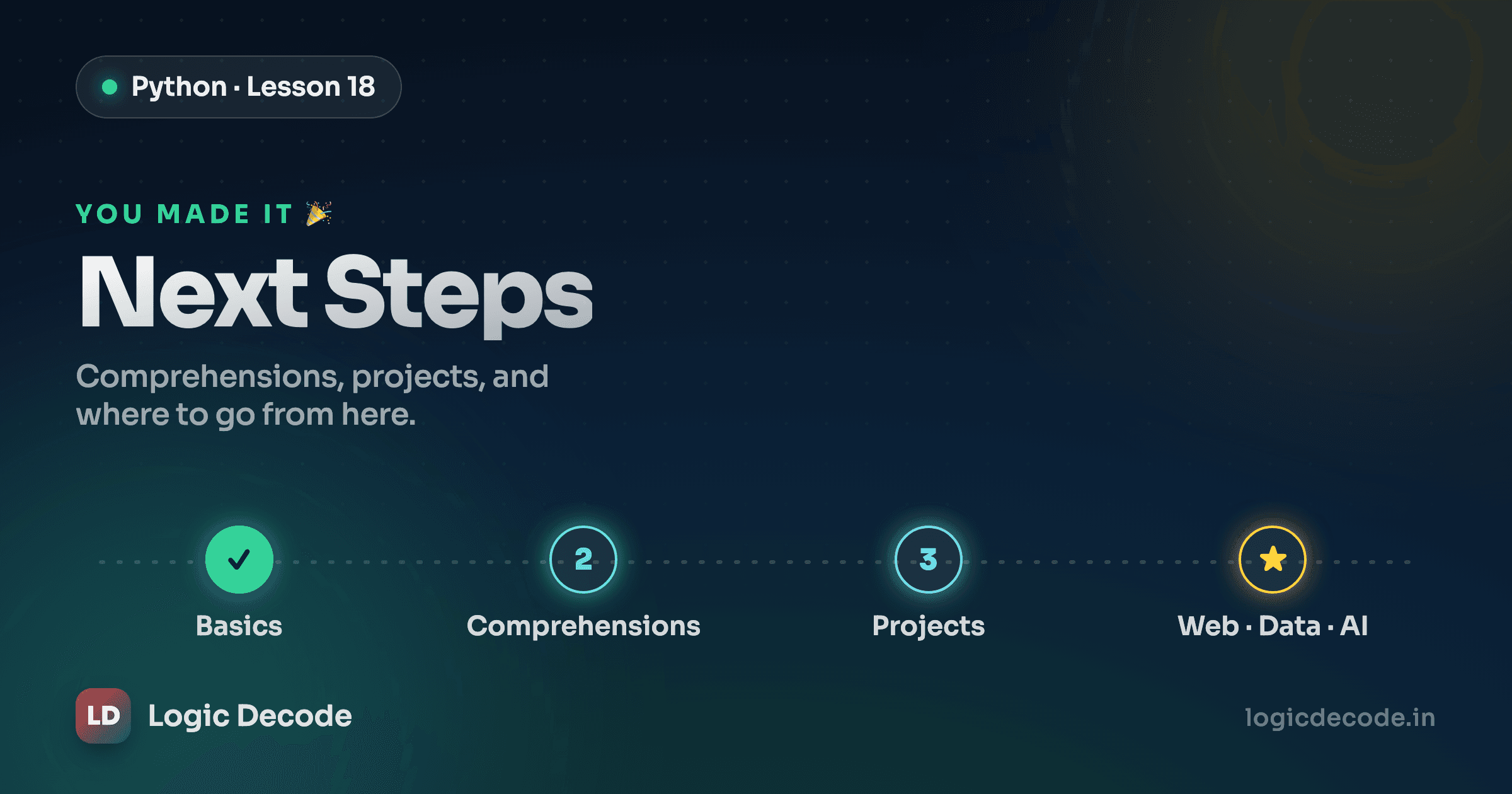
You can read and write real Python now. Variables, loops, functions, classes, files: that's not a starter kit, that's the actual job. This post turns what you've built into momentum, with one last language feature that makes your code shorter and sharper, then an honest map of where to go from here.
List and dict comprehensions
Here's a loop you've written a dozen times by now. Take some numbers, square each one, collect the results:
squares = []
for n in range(4):
    squares.append(n * n)
print(squares)   # [0, 1, 4, 9]
Four lines to build one list. Python has a one-liner that does the exact same thing, called a list comprehension:
squares = [n * n for n in range(4)]
print(squares)   # [0, 1, 4, 9]
Read it left to right: give me n * n for every n in range(4). The square brackets say "build a list." Same result as the loop, a quarter of the code, and once your eye is trained it reads faster than the longhand because the intent is right there on one line.
The pattern isn't limited to lists. Swap the brackets for braces and add a key: value and you get a dict comprehension:
squares = {n: n * n for n in range(4)}
print(squares)   # {0: 0, 1: 1, 2: 4, 3: 9}
That maps each number to its square in one pass. You'd reach for it whenever you want a lookup table built from a sequence: a name-to-score dict, a word-to-count dict, anything shaped like "for each thing, store something about it."
Run both and watch the output:
A word of restraint: comprehensions are great for short, clear transformations. If you find yourself cramming three conditions and a nested loop into one, that's a regular for loop wearing a costume. Write the plain loop. Readable beats clever every time.
Quick check
What is [n * n for n in range(4)] equal to?
What you've learned
Eighteen lessons back you ran print('Hello, Logic Decode!') in a browser and watched it work. Look at the distance you've covered since.
You started with the basics: printing, storing values in variables, reading input, converting types. Then you taught your programs to repeat themselves with loops, so a hundred lines of copy-paste became three. You packaged logic into reusable functions and started thinking in pieces instead of one long script. And you built your own data types with classes, bundling data and behavior into objects you design.
Along the way you also picked up strings, lists, dictionaries, conditionals, files, modules, and error handling. None of that was busywork. That's the toolkit every Python program is made of, including the ones you'll write next. You're past the point where the language is the hard part.
Where to go next
The fun problem now is too much choice. Python goes everywhere, so picking a direction matters more than picking the "right" one. Here are three solid paths, each with a real library to start on.
Web development. Want to put something on the internet, like a personal site, an API, or a tool other people log into? This is your lane. Flask is the gentle start: a tiny framework where you wire up a few routes and you've got a working web app in an afternoon. Django is the heavyweight, batteries included: an admin panel, database models, and authentication ready out of the box, which is why companies build serious products on it. Start with Flask to understand the moving parts, graduate to Django when you want the batteries.
Data and AI. This is Python's home turf, and it's why so many people learn the language at all. pandas lets you load a spreadsheet or CSV and slice, filter, and summarize it in a few lines. Think Excel, but programmable and repeatable. Under it sits NumPy, which makes math on big arrays of numbers fast. Together they're the foundation the entire data and machine-learning stack is built on, so this is the path to take if charts, analysis, or modern AI is what pulled you in.
Automation and scripting. This is where most people feel the payoff first, and it needs almost no new libraries. A short script can rename every file in a folder, pull data off a web page, reformat a messy spreadsheet, or back things up on a schedule. Anything you do by hand on a computer over and over is a candidate. The standard library alone (os, pathlib, csv) covers a huge amount; add requests when you need to talk to the web. It's the lowest-effort way to make Python pay for itself.
Habits that make you better
Read the error message. The whole error message, bottom line first. You practiced this in the exceptions post, and it's the single habit that separates people who get unstuck from people who stare at a screen. Python's tracebacks tell you the file, the line, and what went wrong, in plain-ish English. Most "I'm stuck" moments are answered in text the reader skipped right past.
Build small programs for problems you actually have. Not tutorials, not exercises from a book: your problems. The script you write to sort your downloads folder will teach you more than ten worksheets, because you care whether it works and you'll fight to fix it when it doesn't.
Read other people's code. Open a small library you use, or browse a project on GitHub, and trace how it's put together. You'll see patterns you wouldn't have invented, pick up cleaner ways to write things you already do, and slowly absorb what good Python looks like. It feels slow. It compounds.
Tip
The fastest way to improve is to build tiny programs for problems you actually have. A script that renames your files, a 30-line budget tracker, a tool that checks a website for you, anything real. Real stakes, however small, teach faster than any exercise set.
You're a programmer now
When this series started, the question was whether Python was worth learning at all. You've answered it the only way that counts: by writing the code. You can build with this language now, and everything ahead is the same loop you've already run eighteen times — try something, watch it break, read the error, fix it, run it again. That loop never changes. You just point it at bigger things.
So point it somewhere. Pick one path above, find a problem you genuinely want solved, and build the small ugly first version this week. That's how every programmer you admire started, and now you're one of them.
Want to revisit anything or pick up a lesson you skimmed? It's all waiting in the Python for Beginners series. Thanks for coding along.

Written by
Rhythm Bhiwani
Engineer and relentless builder, happiest reverse-engineering hard problems until they click.
Enjoyed this?
Tap the heart to leave some love.
Be the first to react
Comments
Join the conversation.
Loading comments…