Why Data Structures & Algorithms (and How to Think About Speed)
What DSA really is, why 'it works' and 'it works at scale' are different problems, and how to reason about cost, with a live growth chart and runnable Python.

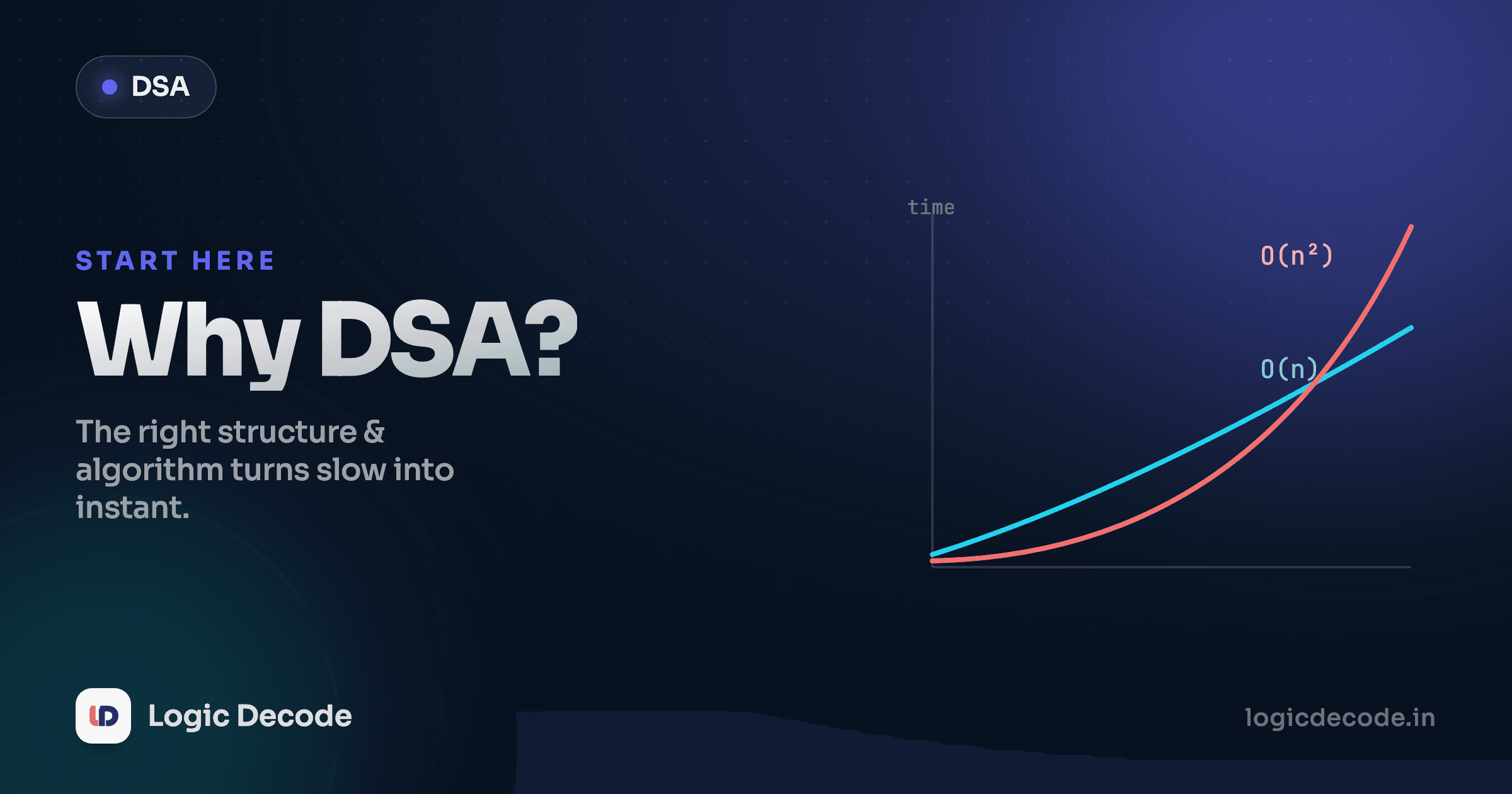
Two programs can solve the exact same problem and give the exact same answer, and one of them finishes before you blink while the other locks up your laptop for ten minutes. They're both "correct." Only one of them is usable. The gap between those two is what data structures and algorithms is about.
"Works" and "works at scale" are different problems
When you're learning to code, the bar is simple: does the output match what you expected? You write a loop, you get the right answer on your three test inputs, you move on. That's the "works" stage, and it's a real milestone.
Then the input grows. The list isn't 3 items, it's 3 million. The user table isn't your test data, it's every signup since launch. Suddenly the code that passed every test is the thing taking down the server. Nothing about the logic was wrong. The problem is that the cost of that logic grows faster than anyone noticed.
A data structure is how you organize data so you can get at it efficiently: a list, a lookup table, a tree. An algorithm is the step-by-step method you run over that data. Search it, sort it, find the shortest path through it. DSA is the study of which combinations stay fast as the input grows, and which ones quietly fall apart.
This is also why every technical interview circles back to it. Companies aren't checking whether you can write a loop. They're checking whether you can tell, before you ship it, which version of the loop survives a million users.
The thing that changes everything: how cost grows
Here's the mental shift. Don't ask "how long does this take?" Ask "how does the time change when the input doubles?" That's the question that predicts the future.
Some approaches barely flinch when the input grows. Double the data, do roughly twice the work, annoying but survivable. Other approaches go off a cliff: double the data and you do four times the work, then sixteen, then it's hopeless. They look identical on small inputs. They diverge violently on large ones.
The chart below makes that divergence concrete. Slide the input size up and watch how far apart the curves get. At n = 10 they're all bunched together and the differences feel academic. Push n higher and the steep curves rocket off the top of the chart while the flat ones barely move. That spread is the entire reason DSA exists.
Big-O growth
The labels (O(1), O(n), O(n²), and friends) are Big-O notation, the language for naming those curves. That's the whole next lesson. For now, just internalize the shapes: flat-ish curves scale, steep curves don't, and the difference only shows up at scale.
See the gap yourself
Let's make this real with a tiny problem: does a list contain any duplicate values?
The obvious approach is to compare every item against every other item, a loop inside a loop. It works perfectly. The set-based approach remembers what it's already seen and checks each item once. Also works perfectly. Same answer, wildly different cost.
The code below runs both on the same input and counts the actual operations each one performs, so you can see the gap instead of taking my word for it. Run it, then bump n up to 50 or 100 and run it again. Watch how differently the two counters grow.
At n = 20 the nested loop does 190 comparisons. The set version does 20. Push n to 100 and it's 4,950 versus 100. The set version asks Python "have I seen this before?" in roughly constant time per item (that's the hash-map magic in lesson four), so it scans the list once. The nested loop re-checks everything against everything, so its work grows like the area of a square. Both are "correct." Only one of them you'd ship.
The cost in Big-O terms
The nested loop is O(n²) time, work proportional to the square of the input. The set version is O(n) time and O(n) space (it stores up to n items in the set). That space-for-speed trade is one of the most common moves in all of DSA: spend a little memory to avoid a lot of repeated work.
How to actually think about it
You don't need to count operations by hand for every line you write. The practical habit is smaller than that:
- Spot the nested loops. A loop inside a loop over the same data is usually O(n²), the first thing to question when something's slow.
- Reach for the right structure. "Have I seen this?" and "look this up by key" are signals to use a set or a dictionary, not a scan.
- Care about the curve, not the clock. A version that's slower on 10 items but flatter as
ngrows wins the moment the data is real.
That's the lens this whole series teaches you to use by reflex.
Where to go next
Two programs, same answer, completely different fate at scale. That's the whole game, and you just watched the operation counters prove it. The skill is learning to predict that gap before you hit it, and that starts with naming the curves precisely.
Next: Big-O Notation, the exact language for "how does cost grow," so you can read the shape of any piece of code at a glance. If you want to shore up the Python first, the loops and functions lessons from the Python series cover everything used above.

Written by
Rhythm Bhiwani
Engineer and relentless builder, happiest reverse-engineering hard problems until they click.
Enjoyed this?
Tap the heart to leave some love.
Be the first to react
Comments
Join the conversation.
Loading comments…