Claude Science: Why the Model Isn't the Moat
Anthropic's Claude Science runs the same Opus 4.8 you already have. The product is the workflow layer, not the model. Here's why that matters for builders.

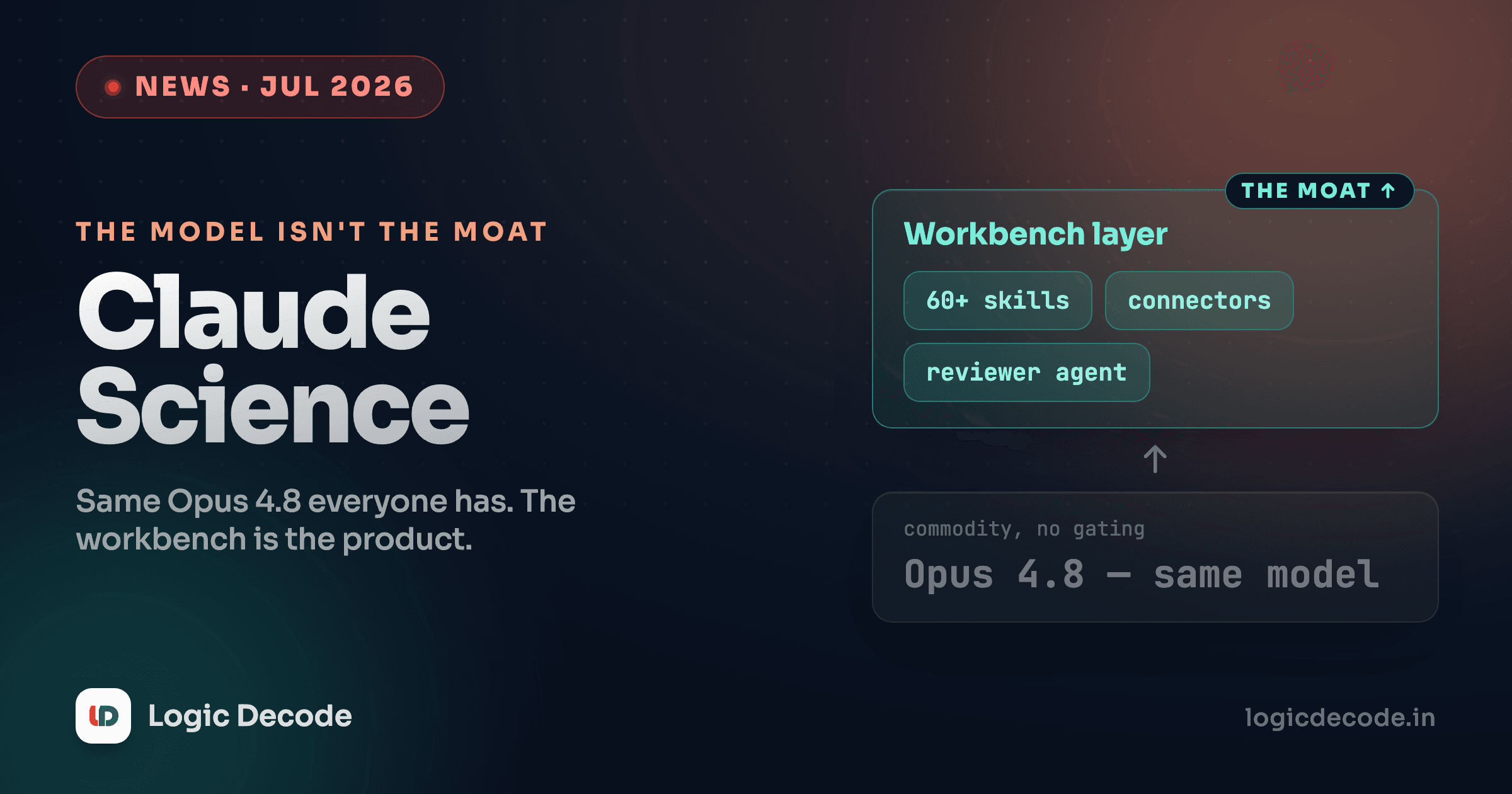
Anthropic shipped Claude Science on June 30. The headline feature is the one nobody expected: there's no new model. It runs the same Claude you already call, Opus 4.8 included, with no special access and no gating. So why would a pharmaceutical lab pay for it?
That question is the whole story. The model is turning into the commodity. The product is everything wrapped around it.
What Claude Science actually is
It's an app for scientists. You talk to one coordinating agent, and behind that agent sits a workbench: more than 60 curated skills and connectors, pre-wired for genomics, single-cell analysis, proteomics, structural biology, and cheminformatics. It plugs straight into the databases researchers live in, like UniProt, PDB, Ensembl, ChEMBL, and ClinVar, plus NVIDIA's BioNeMo toolkit for jobs like protein-structure prediction.
Ask it something and it doesn't just answer in text. It writes the code, runs that code on real compute (an HPC cluster over SSH, or Modal for on-demand GPUs), and hands back figures you can actually put in a paper. It renders 3D protein structures, genome browser tracks, and chemical structures right in the app, then drafts the manuscript around them. It's in beta on macOS and Linux for Pro, Max, Team, and Enterprise users.
The early results Anthropic put names on are not small. A lab at the UCSF Brain Tumor Center, led by Stephen Francis, reports germline analysis workups in roughly a tenth of the time they used to take. Jérôme Lecoq, a neuroscientist at the Allen Institute, built about 20 custom skills into a literature-review pipeline and went from a workflow that took close to two years to finishing around ten reviews, several of them over 100 pages, with citations checked by a reviewer agent.
"Not a new model" is the whole point
Anthropic said it flat out. Claude Science is, in their words, "not a new AI model and not a more capable model for biology." It's the same models you can already call today.
If that strategy sounds familiar, it should. It's the Claude Code playbook again. Claude Code didn't win developers with a secret coding model. It won with the harness around the model: the file access, the tool calls, the loop that edits, runs, and checks its own work. Claude Science is that same bet aimed at the lab bench instead of the codebase.
Here's the thesis underneath it. As raw model quality converges and token prices keep sliding, the model stops being the thing you sell. The defensible part climbs up the stack into the workflow, where someone has done the unglamorous work of wiring the model to real tools, real data, and a way to trust the output.
The three things that are actually the moat
Strip Claude Science down and the value isn't in the weights. It's in three pieces of plumbing, and all three are workflow, not model.
Domain skills and connectors
A general model knows what UniProt is. What it doesn't have is a live connection to it, a tested skill for pulling a protein record, and 60 of those curated and wired together so they compose. That integration is real work, and it's the same shape of work for biologists as it is for your own company's internal data. If you've ever built an agent from scratch, you know the tool list is where most of the effort goes, not the prompt. Tool calling is the easy mechanism. Curating a trustworthy set of tools is the hard, valuable part.
Reproducibility baked in
Every figure ships with the exact code and environment that produced it, a plain-language note on how it was made, and the full message history behind it. Ask for a change in plain English and the agent edits its own code and reruns. In a field where a result nobody can reproduce is worthless, that provenance is the feature. And it's worth copying for any AI output you'll have to defend later, scientific or not.
A reviewer that checks the work
A separate reviewer agent inspects outputs and flags incorrect citations, untraceable numbers, and figures that don't match the code that made them, then self-corrects before you ever see the result. This is the folder-of-files agent idea in practice: one agent hands work to a sub-agent whose whole job is to be skeptical. A coordinator that delegates to a critic is a pattern you can build today, in any stack.
Quick check
According to Anthropic, what makes Claude Science valuable to scientists?
Does it hold up?
The honest answer is "promising, with asterisks."
The time savings are real and named, which is more than most launches offer. But treat the eye-popping numbers as direction, not as a benchmark you'll hit. They come from Anthropic describing pilots on a platform Anthropic is selling.
There's also a sharper limit. The reviewer that fact-checks the work runs on the same underlying model as the work itself. It catches a citation that doesn't resolve or a number with no source, and that's genuinely useful. It is not an independent source of truth, so it doesn't make hallucination go away. A scientist still has to be the final check.
Read the wins as direction, not a guarantee
A tenth of the time, a two-year process done in weeks: these are pilot results the vendor is reporting. The useful signal isn't the exact multiple. It's that real labs at UCSF and the Allen Institute built load-bearing workflows on this and put their names on the outcomes.
If you want to try it on real research, Anthropic is funding up to 50 projects with as much as $30,000 in credits each (Modal is adding up to $2,000 of compute per project). Applications for the AI for Science program are open through July 15, 2026, with projects running September through December. Details are in the Claude Science announcement.
What to take from this
You may never open Claude Science. The architecture is still worth stealing, because it's a clean template for any serious agent: a coordinator that delegates, a curated set of domain skills and connectors, artifacts that carry their own proof, and a reviewer whose only job is to find what's wrong.
The bigger lesson is about where value is moving. When TechCrunch summed up the launch as a bet on "workflow, not a new model," that wasn't a knock. It's the strategy. Anthropic first did this for code with Claude Code, and now it's doing it for science, building on the Claude for Life Sciences groundwork it laid last October.
If the models everyone can call are roughly as good as each other, the winner is whoever wraps them in the workflow people actually need. That's true for a pharma workbench. It's just as true for whatever you're building.

Written by
Rhythm Bhiwani
Engineer and relentless builder, happiest reverse-engineering hard problems until they click.
Enjoyed this?
Tap the heart to leave some love.
Be the first to react
Comments
Join the conversation.
Loading comments…